Würzburg ToCoTronics Colloquium
"Topological i-Wave Surface Superconductivity in PtBi2"
| Datum: | 26.11.2026, 16:15 - 25.06.2026, 18:00 Uhr |
| Kategorie: | Kolloquium |
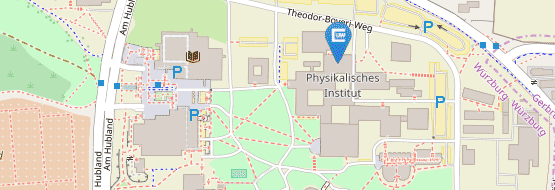
| Ort: | Hubland Süd, Geb. P1 (Physik), HSP P (Röntgen HS) |
| Veranstalter: | SFB 1170 ToCoTronics |
| Vortragende: | Prof. Dr. Bernd Büchner - Leibniz Institute for Solid State and Materials Research Dresden |
PtBi₂ is a promising platform for topological superconductivity, with the strongest evidence so far coming from angle-resolved photoemission spectroscopy (ARPES). I will show that in the non-centrosymmetric Weyl semimetal and van der Waals material PtBi₂, superconductivity is intrinsically confined to the surface. Below about 20 K, ARPES detects a gap opening selectively on the topological Fermi-arc states, while the bulk-derived states remain ungapped, as revealed by ARPES and bulk-sensitive measurements. High-resolution ARPES further points to a nodal gap structure, consistent with unconventional pairing and a topological superconducting surface state.
A diamagnetic response appears in the same temperature range only in AC susceptibility, but not in the DC Meissner signal, indicating strong superconducting fluctuations. These fluctuations persist to low temperatures and are also observed by scanning SQUID microscopy. STM reveals the remarkable potential of this system, with some surfaces showing very large gap values, high apparent transition temperatures, and high critical fields. However, STM and scanning SQUID microscopy also reveal strong variations between different surfaces, indicating a sensitivity to local surface conditions, possibly influenced by defects, strain, or morphology.
Because the superconducting surface states arise from the bulk Weyl topology, PtBi₂ provides an intrinsic interplay between bulk topology and surface superconductivity and may represent a rare case of superconductivity confined to the surface alone. Based on the nodal gap structure observed by ARPES, theory suggests a topological i-wave state intrinsically involving the two inequivalent surfaces. PtBi₂ thus emerges as a compelling, but complex, candidate for intrinsic topological surface superconductivity.