Würzburg Seminar on Quantum Field Theory and Gravity (Leo Shaposhnik, 13.10.2016)
On the Relation between Maximal Chaos and Emergent Spacetime from Modular Theory
| Date: | 10/13/2026, 2:15 PM - 3:15 PM |
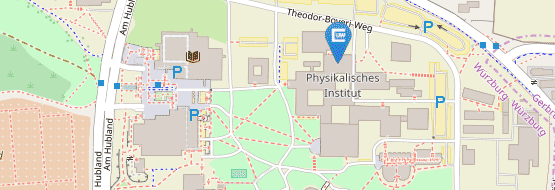
| Location: | Hubland Süd, Geb. P1 (Physik), Seminar Room 4 |
| Organizer: | Lehrstuhl für Theoretische Physik III |
| Speaker: | Leo Shaposhnik |
What properties of a quantum mechanical system imply that its dynamics can be encoded in a higher-dimensional quantum gravitational theory, and when is this theory semiclassical? Over the past two decades, a growing body of evidence has suggested that maximal scrambling dynamics of the quantum mechanical system are necessary for a semiclassical bulk to emerge. A more fundamental understanding of this relationship has only been achieved for conformal field theories. More recently, understanding the emergence of spacetime from the perspective of algebraic quantum field theory has given rise to new insights into this relationship and allowed for more general definitions of emergent bulk features, such as causal horizons, without needing to assume conformal symmetry. One fundamental aspect of causal horizons is that they are accompanied by a specific algebraic structure—so-called half-sided modular inclusions—which prominently feature a growing mode whose exponential growth is reminiscent of the chaos bound of Maldacena, Shenker and Stanford, which is famously saturated by semiclassical gravity. However, a precise relationship between this “modular chaos”, emergent gravity and the chaos bound for OTOCs is currently unavailable. This talk will provide further evidence for a connection between these subjects by demonstrating that, in maximally chaotic systems like SYK, the saturation of the chaos bound indeed arises from the emergence of half-sided modular inclusions in the large-N limit.