Recent Publications

Oxide interface-based polymorphic electronic devices for neuromorphic computing

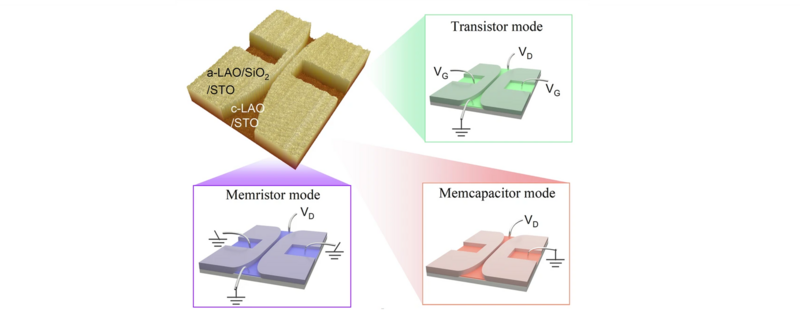
Aside from recent advances in artificial intelligence (AI) models, specialized AI hardware is crucial for addressing large volumes of unstructured and dynamic data. Conventional complementary metal-oxide-semiconductor (CMOS)-based AI hardware faces several critical challenges including scaling limitations, the separation of computation and memory units, and overall system energy efficiency. While emerging materials have been proposed to overcome these limitations, issues such as scalability, reproducibility, and compatibility remain critical obstacles. Here, we demonstrate polymorphic electronic devices with programmable transistor, memristor, and memcapacitor functionalities by manipulating the quasi-two-dimensional electron gas in LaAlO3/SrTiO3 heterostructures using lateral gates... 

Nat. Commun. 17, 3406 (2026)


Gate-controlled analog memcapacitance in LaAlO3/SrTiO3 interface-based devices

We demonstrate memcapacitor structures utilizing a quasi-two-dimensional electron gas, formed at the crystalline LaAlO3/SrTiO3 heterointerface, as electrodes and SiO2/SrTiO3 as dielectric layer. The observed memcapacitance originates from charge localization in a lateral floating gate, while an applied gate voltage induces a threshold voltage shift of approximately 1 V and enables reversible tuning of the zero-bias capacitance from ∼147 to ∼386 pF. Furthermore, preprogrammed or erased gate voltages enable controllable shifts of the capacitance hysteresis window toward positive or negative bias, leading to an enlarged capacitance gap of 243 pF compared to the initial value of 100 pF at zero bias...

Appl. Phys. Lett. 128, 123504 (2026)


Inducing ferromagnetism by structural engineering in a strongly spin-orbit coupled oxide

Magnetic materials with strong spin-orbit coupling (SOC) are essential for the advancement of spin-orbitronic devices, as they enable efficient spin-charge conversion, complex magnetic structures, spin-valley physics, topological phases and other exotic phenomena. 5d transition-metal oxides such as SrIrO₃ feature large SOC, but usually show paramagnetic behavior due to broad bands and a low density of states at the Fermi level, accompanied by a relatively low Coulomb repulsion. Here, we unveil ferromagnetism in 5d SrIrO3 thin films grown on SrTiO(111). Through substrate-induced structural engineering, a zigzag stacking of three-unit-cell thick layers along the [111] direction is achieved, stabilizing a ferromagnetic state at the interfaces... 

Adv. Funct. Mater., 0:e00032 (2026) 


Research Groups

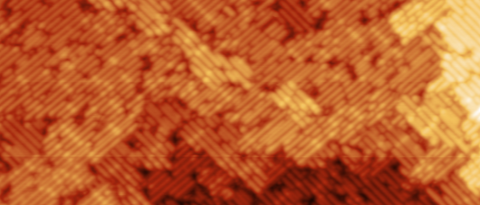
Nanophysics at surfaces

The research activities of our group are concerned with the physics of low-dimensional systems, where the electron states resulting from dimensional confinement lead to unusual conduction properties and to phase transitions as a function of temperature.

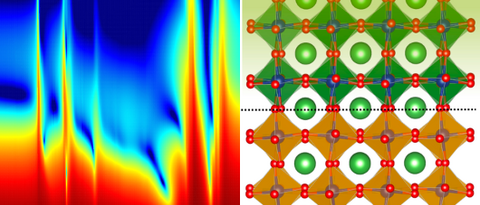
Oxide interfaces

Our group focusses on the electronic structure of correlated systems in transition metal oxides (TMOs). Special interest lies in the interplay of different degrees of freedom (charge, spin, orbital, lattice) in the light of metal-insulator and other phase transitions.

Neutron and resonant X-ray spectroscopy

In our group we investigate complex, functional materials such as transition metal oxides, which are used in the emerging field of correlated nanoelectronics. Unlike with conventional semiconductors, exotic superconducting, orbital and magnetic states can be realized at the interfaces in layered structures comprising such materials.

Cooperations