Recent Publications

Realization of triangular antimonene with high in-plane Fermi velocities

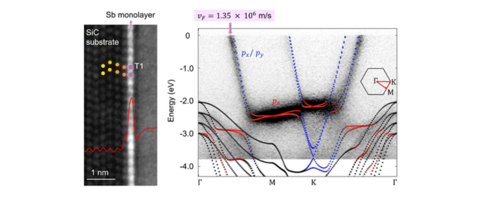
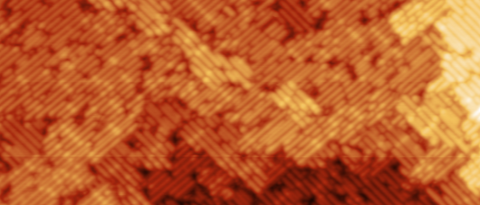
Two-dimensional materials with high Fermi velocities are promising for high-speed electronic and optoelectronic applications, yet experimental realizations beyond graphene remain scarce. Here, we report the successful synthesis of a triangular monolayer of antimony (Sb) on the wide-gap semiconductor SiC. Using combined angle-resolved photoemission spectroscopy (ARPES) and scanning transmission electron microscopy (STEM) in combination with density functional theory (DFT), we reveal substrate-engineered orbital filtering that isolates broad-bandwidth, highly dispersive px and py bands, yielding a compensated Fermi surface with an ultrahigh Fermi velocity surpassing that of pristine graphene. ... 

Nano Lett. 26, 16126 (2026)

Turning graphene into an intensity gauge for angle-resolved photoemission spectroscopy

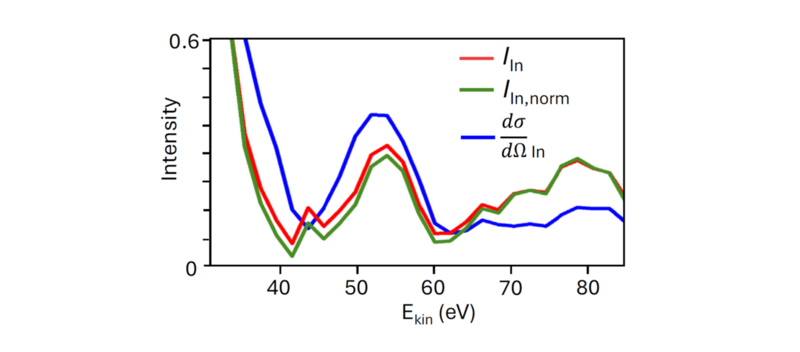
Angle-resolved photoemission spectroscopy (ARPES) provides the most direct experimental access to electronic band structures and many-body interactions in solids. Beyond energy and momentum, the measured intensity also carries detailed information about the initial-state wavefunction through the complex photoemission matrix element governing the transition to—and scattering character of—the photoelectron final state. Orbital tomography seeks to exploit this sensitivity to reconstruct electronic wavefunctions. However, its quantitative implementation has been hindered by the lack of direct information on the phase of the matrix element and by the nontrivial role of solid-state scattering. Here, we overcome these limitations by achieving an experimental reconstruction of the complex photoemission matrix element in quasi-freestanding monolayer graphene (QFMLG), including both amplitude and phase. ...

Phys. Rev. Res. 8, 043081 (2026)


Single-Domain Orbital Angular Momentum Mapping: Advancing Photoemission Dichroism to the Nanoscale

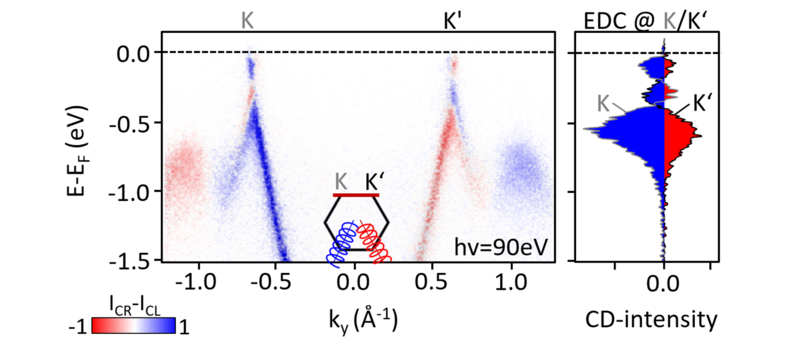
Circular dichroism in angle-resolved photoemission spectroscopy (CD-ARPES) is widely used to probe orbital angular momentum (OAM) and Berry-curvature-related phenomena in two-dimensional quantum materials. However, in many materials, conventional micron-scale measurements often average over domains with opposite OAM polarization, canceling intrinsic dichroic signals and leaving spectra dominated by extrinsic asymmetries arising from photoelectron final-state interference. Here, we combine circularly polarized light with NanoARPES to achieve spatially resolved CD-ARPES with sub-800 nm resolution. By isolating individual domains, this approach enables...

ACS Nano 20, 27867 (2026)


Research Groups

Nanophysics at surfaces

The research activities of our group are concerned with the physics of low-dimensional systems, where the electron states resulting from dimensional confinement lead to unusual conduction properties and to phase transitions as a function of temperature.

Oxide interfaces

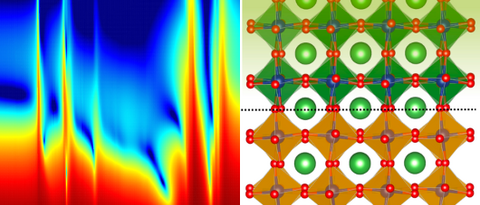
Our group focusses on the electronic structure of correlated systems in transition metal oxides (TMOs). Special interest lies in the interplay of different degrees of freedom (charge, spin, orbital, lattice) in the light of metal-insulator and other phase transitions.

Neutron and resonant X-ray spectroscopy

In our group we investigate complex, functional materials such as transition metal oxides, which are used in the emerging field of correlated nanoelectronics. Unlike with conventional semiconductors, exotic superconducting, orbital and magnetic states can be realized at the interfaces in layered structures comprising such materials.

Cooperations