Recent Publications

Single-Domain Orbital Angular Momentum Mapping: Advancing Photoemission Dichroism to the Nanoscale

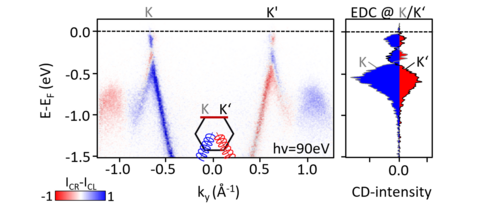
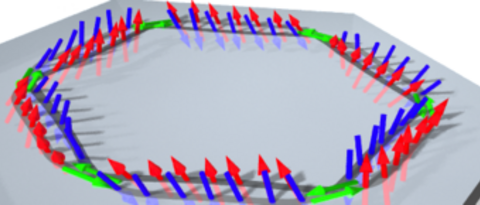
Circular dichroism in angle-resolved photoemission spectroscopy (CD-ARPES) is widely used to probe orbital angular momentum (OAM) and Berry-curvature-related phenomena in two-dimensional quantum materials. However, in many materials, conventional micron-scale measurements often average over domains with opposite OAM polarization, canceling intrinsic dichroic signals and leaving spectra dominated by extrinsic asymmetries arising from photoelectron final-state interference. Here, we combine circularly polarized light with NanoARPES to achieve spatially resolved CD-ARPES with sub-800 nm resolution. By isolating individual domains, this approach enables...

ACS Nano (2026)

Moiré-resonant surface state in ultrathin RuO2⁢(110)

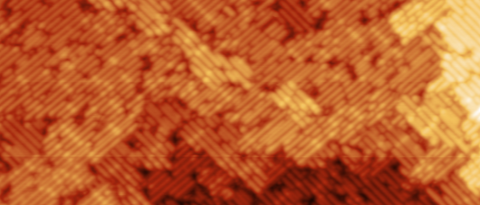
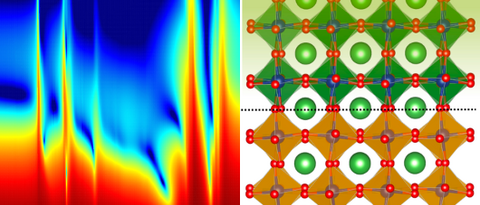
RuO2 has emerged as a prototypical candidate for altermagnetism. In the face of daunting evidence for magnetic order in the bulk, the focus naturally shifted to surfaces and ultrathin films, where Coulomb interactions are dimensionally quenched and electron correlations strongly enhanced. Here, we examine atomically ordered, ultrathin RuO2⁢(110) grown on Ru⁡(0001) using a combination of scanning tunneling microscopy (STM), density functional theory, and density matrix renormalization group methods. We observe a nonmagnetic charge order that is imprinted by the incommensurate moiré stacking with the substrate and enhanced by the electronic Fermi-surface scattering within the flat-band surface state. ...

Phys. Rev. Res. 8, 033058 (2026)


Oxide interface-based polymorphic electronic devices for neuromorphic computing

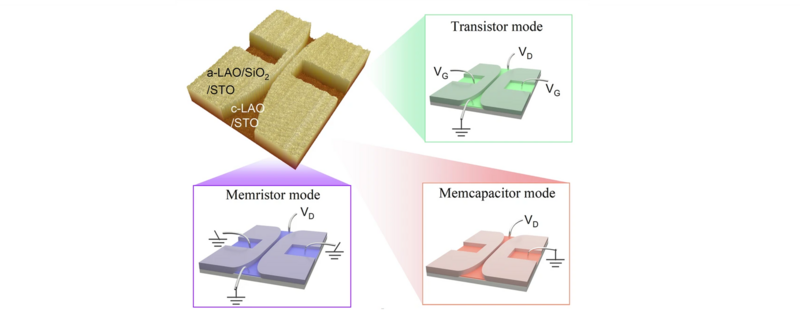
Aside from recent advances in artificial intelligence (AI) models, specialized AI hardware is crucial for addressing large volumes of unstructured and dynamic data. Conventional complementary metal-oxide-semiconductor (CMOS)-based AI hardware faces several critical challenges including scaling limitations, the separation of computation and memory units, and overall system energy efficiency. While emerging materials have been proposed to overcome these limitations, issues such as scalability, reproducibility, and compatibility remain critical obstacles. Here, we demonstrate polymorphic electronic devices with programmable transistor, memristor, and memcapacitor functionalities by manipulating the quasi-two-dimensional electron gas in LaAlO3/SrTiO3 heterostructures using lateral gates... 

Nat. Commun. 17, 3406 (2026)


Research Groups

Nanophysics at surfaces

The research activities of our group are concerned with the physics of low-dimensional systems, where the electron states resulting from dimensional confinement lead to unusual conduction properties and to phase transitions as a function of temperature.

Oxide interfaces

Our group focusses on the electronic structure of correlated systems in transition metal oxides (TMOs). Special interest lies in the interplay of different degrees of freedom (charge, spin, orbital, lattice) in the light of metal-insulator and other phase transitions.

Neutron and resonant X-ray spectroscopy

In our group we investigate complex, functional materials such as transition metal oxides, which are used in the emerging field of correlated nanoelectronics. Unlike with conventional semiconductors, exotic superconducting, orbital and magnetic states can be realized at the interfaces in layered structures comprising such materials.

Cooperations