

Dr. Simon Betzold
Dr. Simon Betzold
University of Würzburg
Am Hubland




Dr. Simon Betzold is a tenured group leader and lecturer at the Chair of Technische Physik at the University of Würzburg, where he leads the Polaritonics Group. His research focuses on light-matter coupled systems in semiconductor microcavities, with particular emphasis on exciton-polaritons, hybrid material platforms, and engineered photonic structures.
The group investigates fundamental questions in driven quantum matter, including non-equilibrium dynamics, emergent collective behavior, and topological phenomena, while exploring routes toward novel photonic functionality enabled by semiconductor platforms. Research spans the full experimental chain, from semiconductor growth and nanofabrication to advanced optical spectroscopy and ultrafast measurements. This integrated approach links fundamental physics, experimentally realizable structures, and emerging device concepts.
The group offers opportunities for students at all levels to work on current research topics in a collaborative and hands-on environment, with training at the interface of quantum physics, semiconductor technology, and photonic engineering.
Hybrid Polaritonics and Topological Light-Matter Systems
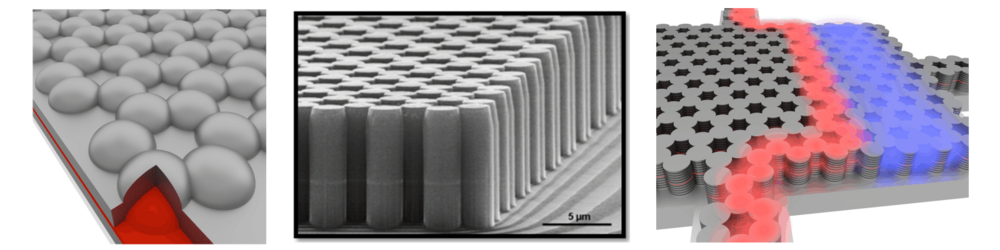
The Hybrid Polaritonics Group investigates controllable light-matter coupled systems as a platform for exploring emergent phenomena in open quantum matter and for developing novel photonic functionalities. Our research combines semiconductor microcavities, low-dimensional materials, and engineered photonic structures to study strong coupling, non-equilibrium quantum dynamics, universal scaling phenomena, and topological effects. By integrating optical, electrical, and structural control, we address fundamental questions while exploring routes toward functional polaritonic devices and scalable quantum-photonic architectures.
Polaritonics and Quantum Fluids of Light
High-quality semiconductor microcavities with embedded quantum wells enable strong coupling between excitons and photons, giving rise to exciton-polaritons: hybrid quasiparticles that provide a versatile platform for studying coherent many-body physics far from equilibrium. Their driven-dissipative character allows access to collective phenomena ranging from polariton condensation and nonlinear quantum fluids to emergent universal behavior beyond equilibrium physics. Our research focuses on:
- Optically and electrically driven polariton condensation
- Coherence, interactions, and non-equilibrium quantum dynamics
- Universal scaling, phase ordering, and driven-dissipative stochastic dynamics, including KPZ physics
- Advanced polaritonic devices and experimentally controllable quantum fluid platforms
These directions connect quantum optics, condensed matter physics, and non-equilibrium statistical physics in a strongly experimental environment.
Topological Polaritonic Systems
We investigate polaritons in engineered lattices and photonic networks to realize non-trivial band structures and topological phases in driven photonic systems. By tailoring coupling, geometry, interactions, and external control parameters, we explore:
- Topological edge and corner states
- Polariton transport in lattices and networks
- Higher-order topological phases
- Dynamically reconfigurable photonic structures
A central objective is active control over topological properties through optical excitation and electrical tuning, linking fundamental topological physics with robust and functional photonic architectures.
Hybrid Organic-Inorganic Systems
By combining organic semiconductors with inorganic microcavities, we develop hybrid systems that unite complementary material advantages, including strong excitonic effects, electrical tunability, and efficient light generation. Current directions include:
- Hybrid strong-coupling platforms
- Electrical control and device integration
- Polariton gain and nonlinear emission
- Novel hybrid photonic devices and polariton lasers
These systems provide a testbed for both fundamental light-matter physics and scalable photonic concepts.
Contact us. We welcome inquiries from prospective students, postdocs, academic collaborators, and industry partners.
For more information on our research, opportunities, or to schedule a visit to our lab, please contact us via email, phone, or social media.
Join us. We continuously offer Bachelor, Master, and PhD projects in polaritonics, semiconductor photonics, and topological light-matter systems.
Projects involve experimental work across:
- Optical spectroscopy and interferometry
- Semiconductor micro- and nanofabrication
- Structured light control and advanced photonic measurements
- Data analysis and modeling of non-equilibrium systems
Students are integrated into ongoing research projects and gain experience across the full experimental chain — from materials and device fabrication to advanced optical characterization. This broad training provides strong preparation for careers in academic research as well as semiconductor, photonics, and high-technology environments.
We are currently offering the following Bachelor and Master theses:
Optische Charakterisierung hochreflektierender Spiegel
Experimentelle Realisierung von Quadrupol Higher-Order Topological Insulators
Elektrisch steuerbare Dipolaritonen zur Kontrolle von Wechselwirkung & Lasing
Lichtkontrollierte topologische Randzustände in Polaritongittern
| WiSe26/27 | Lecture Introduction to Physics 1 for Non-Physics Majors (Mechanics, Oscillations, Thermodynamics and Optics) |
| Lab course Physikalisches Praktikum im Nebenfach Physik | |
| SoSe26 | Lab course Physikalisches Praktikum im Nebenfach Physik |
| WiSe25/26 | Seminar Advanced Seminar Physics: Advanced Topics on Experimental Physics (Oberseminar) |
| Seminar Advanced Seminar Quantum Engineering: Advanced Topics on Nanosciences (Oberseminar) | |
| Lab course F-Praktikum: Bell's inequality | |
| Lab course Physikalisches Praktikum im Nebenfach Physik | |
| SoSe25 | Lab course F-Praktikum: Bell's inequality |
| Lab course Physikalisches Praktikum im Nebenfach Physik | |
| WiSe24/25 | Exercise class Optik- und Quantenphysik 1 |
| Lab course F-Praktikum: Optical Spectroscopy | |
| Lab course Physikalisches Praktikum im Nebenfach Physik | |
| SoSe24 | Lab course F-Praktikum: Optical Spectroscopy |
| Lab course Physikalisches Praktikum im Nebenfach Physik | |
| WiSe23/24 | Lab course F-Praktikum: Optical Spectroscopy |
| WiSe21/22 | Exercise class Optical Properties of Semiconductor Nanostructures |
| Lab course Physikalisches Praktikum im Nebenfach Physik | |
| Lab course F-Praktikum: Optical Spectroscopy | |
| SoSe21 | Lab course Physikalisches Praktikum im Nebenfach Physik |
Monolithic microcavity-metalens interfaces: bridging performance and complexity in quantum light sources
S. Betzold and S. Höfling
eLight 6 (2026), DOI: 10.1186/s43593-026-00134-z
Hybrid Confinement Techniques for Polariton Simulators
J. Düreth, P. Gagel, D. Laibacher, O. A. Egorov, S. Widmann, S. Betzold, M. Emmerling, S. Dam, A. Landry, C. G. Mayer, M. Kamp, A. Woyciechowska, B. Piętka, U. Peschel, S. Höfling, and S. Klembt
Nano Lett. (2026), DOI: 10.1021/acs.nanolett.5c06090
Embedding monolayers of 2D materials in directly sputtered monolithic cavities for strong light-matter coupling
M. Federolf, S. Sahoo, A. Arora, A. Patra, M. Emmerling, M. Kamp, K. Watanabe, T. Taniguchi, S. Betzold, and S. Höfling
Opt. Mater. Express 16, 84 (2026), DOI: 10.1364/OME.576174
Tuning the non-linear interactions of hybrid interlayer excitons in bilayer MoS 2 via electric fields
M. Federolf, A. Steinhoff, M. Emmerling, M. Florian, S. Betzold, C. Schneider, and S. Höfling
2d Mater. 13, 25028 (2026), DOI: 10.1088/2053-1583/ae566f
Electrical Control of Excitons in Bare MoSe2 and MoSe2/NbSe2 Heterostructures
A. Patra, V. Kaushik, A. Sepas, S. Sahoo, M. Federolf, C. G. Mayer, S. Klembt, M. Emmerling, S. Betzold, S. A. Tongay, F. Hartmann, T. G. Pedersen, and S. Höfling
ACS nano 20, 13958 (2026), DOI: 10.1021/acsnano.6c04866
Artificial gauge fields and dimensions in a polariton hofstadter ladder
S. Widmann, J. Bellmann, J. Düreth, S. Dam, C. G. Mayer, P. Gagel, S. Betzold, M. Emmerling, S. Mandal, R. Banerjee, T. C. H. Liew, R. Thomale, S. Höfling, and S. Klembt
Nat. Commun. 17, 1586 (2026), DOI: 10.1038/s41467-026-68530-0
Observation of Kardar-Parisi-Zhang universal scaling in two dimensions
S. Widmann, S. Dam, J. Düreth, C. G. Mayer, R. Daviet, C. P. Zelle, D. Laibacher, M. Emmerling, M. Kamp, S. Diehl, S. Betzold, S. Klembt, and S. Höfling
Science 392, 221 (2026), DOI: 10.1126/science.aeb4154
Dynamically reconfigurable topological routing in nonlinear photonic systems
S. Wong, S. Betzold, S. Höfling, and A. Cerjan
Light Sci. Appl. 15, 46 (2026), DOI: 10.1038/s41377-025-02108-1
Enwrapped Perylene Bisimide Enables Room Temperature Polariton Lasing and Photonic Lattices
D. Horneber, J. Düreth, T. Schembri, S. Betzold, M. Stolte, S. Höfling, F. Würthner, and S. Klembt
Adv. Opt. Mater. (2025), DOI: 10.1002/adom.202402617
Topological Optical Waveguiding of Exciton‐Polariton Condensates
J. Beierlein, O. A. Egorov, P. Gagel, T. H. Harder, A. Wolf, M. Emmerling, S. Betzold, F. Jabeen, L. Ma, S. Höfling, U. Peschel, and S. Klembt
Ann. Phys. (Berl.) (2024), DOI: 10.1002/andp.202400229
Dirac Cones and Room Temperature Polariton Lasing Evidenced in an Organic Honeycomb Lattice
S. Betzold, J. Düreth, M. Dusel, M. Emmerling, A. Bieganowska, J. Ohmer, U. Fischer, S. Höfling, and S. Klembt
Adv. Sci., e2400672 (2024), DOI: 10.1002/advs.202400672
An Electrically Pumped Topological Polariton Laser
P. Gagel, O. A. Egorov, F. Dzimira, J. Beierlein, M. Emmerling, A. Wolf, F. Jabeen, S. Betzold, U. Peschel, S. Höfling, C. Schneider, and S. Klembt
Nano Lett. (2024), DOI: 10.1021/acs.nanolett.4c00958
Polarized and Unpolarized Emission from a Single Emitter in a Bullseye Resonator
G. Peniakov, Q. Buchinger, M. Helal, S. Betzold, Y. Reum, M. B. Rota, G. Ronco, M. Beccaceci, T. M. Krieger, S. F. C. Da Silva, A. Rastelli, R. Trotta, A. T. Pfenning, S. Höfling, and T. Huber-Loyola
Laser Photonics Rev. (2024), DOI: 10.1002/lpor.202300835
Optical properties of circular Bragg gratings with labyrinth geometry to enable electrical contacts
Q. Buchinger, S. Betzold, S. Höfling, and T. Huber-Loyola
Appl. Phys. Lett. 122, 111110 (2023), DOI: 10.1063/5.0136715
Electro-optical Switching of a Topological Polariton Laser
P. Gagel, T. H. Harder, S. Betzold, O. A. Egorov, J. Beierlein, H. Suchomel, M. Emmerling, A. Wolf, U. Peschel, S. Höfling, C. Schneider, and S. Klembt
ACS Photonics 9, 405 (2022), DOI: 10.1021/acsphotonics.1c01605
Room-Temperature Topological Polariton Laser in an Organic Lattice
M. Dusel, S. Betzold, T. H. Harder, M. Emmerling, J. Beierlein, J. Ohmer, U. Fischer, R. Thomale, C. Schneider, S. Höfling, and S. Klembt
Nano Lett. 21, 6398 (2021), DOI: 10.1021/acs.nanolett.1c00661
Purcell-Enhanced Single Photon Source Based on a Deterministically Placed WSe2 Monolayer Quantum Dot in a Circular Bragg Grating Cavity
O. Iff, Q. Buchinger, M. Moczała-Dusanowska, M. Kamp, S. Betzold, M. Davanço, K. Srinivasan, S. Tongay, C. Antón-Solanas, S. Höfling, and C. Schneider
Nano Lett. 21, 4715 (2021), DOI: 10.1021/acs.nanolett.1c00978
Hyperspectral study of the coupling between trions in WSe 2 monolayers to a circular Bragg grating cavity
O. Iff, M. Davanço, S. Betzold, M. Moczała-Dusanowska, M. Wurdack, M. Emmerling, S. Höfling, and C. Schneider
C. R. Phys. 22, 1 (2021), DOI: 10.5802/crphys.76
Coherence and Interaction in Confined Room-Temperature Polariton Condensates with Frenkel Excitons
S. Betzold, M. Dusel, O. Kyriienko, C. P. Dietrich, S. Klembt, J. Ohmer, U. Fischer, I. A. Shelykh, C. Schneider, and S. Höfling
ACS Photonics 7, 384 (2020), DOI: 10.1021/acsphotonics.9b01300
Room temperature organic exciton-polariton condensate in a lattice
M. Dusel, S. Betzold, O. A. Egorov, S. Klembt, J. Ohmer, U. Fischer, S. Höfling, and C. Schneider
Nat. Commun. 11, 2863 (2020), DOI: 10.1038/s41467-020-16656-0
Optomechanical tuning of the polarization properties of micropillar cavity systems with embedded quantum dots
S. Gerhardt, M. Moczała-Dusanowska, Ł. Dusanowski, T. Huber, S. Betzold, J. Martín-Sánchez, R. Trotta, A. Predojević, S. Höfling, and C. Schneider
Phys. Rev. B 101, 245308 (2020), DOI: 10.1103/PhysRevB.101.245308
Spatio-temporal coherence in vertically emitting GaAs-based electrically driven polariton lasers
H. Suchomel, M. Klaas, S. Betzold, P. Gagel, J. Beierlein, S. Klembt, C. Schneider, and S. Höfling
Appl. Phys. Lett. 116, 171103 (2020), DOI: 10.1063/5.0007456
Polarization-dependent light-matter coupling and highly indistinguishable resonant fluorescence photons from quantum dot-micropillar cavities with elliptical cross section
S. Gerhardt, M. Deppisch, S. Betzold, T. H. Harder, T. C. H. Liew, A. Predojević, S. Höfling, and C. Schneider
Phys. Rev. B 100, 115305 (2019), DOI: 10.1103/PhysRevB.100.115305
Nonresonant spin selection methods and polarization control in exciton-polariton condensates
M. Klaas, O. A. Egorov, T. C. H. Liew, A. V. Nalitov, V. Marković, H. Suchomel, T. H. Harder, S. Betzold, E. A. Ostrovskaya, A. V. Kavokin, S. Klembt, S. Höfling, and C. Schneider
Phys. Rev. B 99, 115303 (2019), DOI: 10.1103/PhysRevB.99.115303
Polariton-lasing in microcavities filled with fluorescent proteins
S. Betzold, C. P. Dietrich, M. Dusel, M. Emmerling, L. Tropf, M. Schubert, N. M. Kronenberg, J. Ohmer, U. Fischer, M. C. Gather, and S. Höfling
Proc. SPIE, Quantum Sensing and Nano Electronics and Photonics XV, 66 (2018), DOI: 10.1117/12.2292045
Tunable Light–Matter Hybridization in Open Organic Microcavities
S. Betzold, S. Herbst, A. A. P. Trichet, J. M. Smith, F. Würthner, S. Höfling, and C. P. Dietrich
ACS Photonics 5, 90 (2018), DOI: 10.1021/acsphotonics.7b00552
Intrinsic and environmental effects on the interference properties of a high-performance quantum dot single-photon source
S. Gerhardt, J. Iles-Smith, D. P. S. McCutcheon, Y.-M. He, S. Unsleber, S. Betzold, N. Gregersen, J. Mørk, S. Höfling, and C. Schneider
Phys. Rev. B 97, 195432 (2018), DOI: 10.1103/PhysRevB.97.195432
Deterministic coupling of quantum emitters in WSe2 monolayers to plasmonic nanocavities
O. Iff, N. Lundt, S. Betzold, L. N. Tripathi, M. Emmerling, S. Tongay, Y. J. Lee, S.-H. Kwon, S. Höfling, and C. Schneider
Opt. Express 26, 25944 (2018), DOI: 10.1364/OE.26.025944
Spontaneous Emission Enhancement in Strain-Induced WSe 2 Monolayer-Based Quantum Light Sources on Metallic Surfaces
L. N. Tripathi, O. Iff, S. Betzold, Ł. Dusanowski, M. Emmerling, K. Moon, Y. J. Lee, S.-H. Kwon, S. Höfling, and C. Schneider
ACS Photonics 5, 1919 (2018), DOI: 10.1021/acsphotonics.7b01053
Observation of bosonic condensation in a hybrid monolayer MoSe2-GaAs microcavity
M. Waldherr, N. Lundt, M. Klaas, S. Betzold, M. Wurdack, V. Baumann, E. Estrecho, A. V. Nalitov, E. Cherotchenko, H. Cai, E. A. Ostrovskaya, A. V. Kavokin, S. Tongay, S. Klembt, S. Höfling, and C. Schneider
Nat. Commun. 9, 3286 (2018), DOI: 10.1038/s41467-018-05532-7
Exciton dynamics in solid-state green fluorescent protein
C. P. Dietrich, M. Siegert, S. Betzold, J. Ohmer, U. Fischer, and S. Höfling
Appl. Phys. Lett. 110, 43703 (2017), DOI: 10.1063/1.4974033
Three-dimensional photonic confinement in imprinted liquid crystalline pillar microcavities
M. Dusel, S. Betzold, S. Brodbeck, S. Herbst, F. Würthner, D. Friedrich, B. Hecht, S. Höfling, and C. P. Dietrich
Appl. Phys. Lett. 110, 201113 (2017), DOI: 10.1063/1.4983565
Valley polarized relaxation and upconversion luminescence from Tamm-plasmon trion–polaritons with a MoSe 2 monolayer
N. Lundt, P. Nagler, A. V. Nalitov, S. Klembt, M. Wurdack, S. Stoll, T. H. Harder, S. Betzold, V. Baumann, A. V. Kavokin, C. Schüller, T. Korn, S. Höfling, and C. Schneider
2d Mater. 4, 25096 (2017), DOI: 10.1088/2053-1583/aa6ef2
Observation of macroscopic valley-polarized monolayer exciton-polaritons at room temperature
N. Lundt, S. Stoll, P. Nagler, A. V. Nalitov, S. Klembt, S. Betzold, J. Goddard, E. Frieling, A. V. Kavokin, C. Schüller, T. Korn, S. Höfling, and C. Schneider
Phys. Rev. B 96 (2017), DOI: 10.1103/PhysRevB.96.241403
Room temperature strong coupling in a semiconductor microcavity with embedded AlGaAs quantum wells designed for polariton lasing
H. Suchomel, S. Kreutzer, M. Jörg, S. Brodbeck, M. Pieczarka, S. Betzold, C. P. Dietrich, G. Sęk, C. Schneider, and S. Höfling
Opt. Express 25, 24816 (2017), DOI: 10.1364/OE.25.024816
Impact of exsitu rapid thermal annealing on magneto-optical properties and oscillator strength of In(Ga)As quantum dots
T. Braun, S. Betzold, N. Lundt, M. Kamp, S. Höfling, and C. Schneider
Phys. Rev. B 93, 155307 (2016), DOI: 10.1103/PhysRevB.93.155307
Room-temperature Tamm-plasmon exciton-polaritons with a WSe2 monolayer
N. Lundt, S. Klembt, E. Cherotchenko, S. Betzold, O. Iff, A. V. Nalitov, M. Klaas, C. P. Dietrich, A. V. Kavokin, S. Höfling, and C. Schneider
Nat. Commun. 7, 13328 (2016), DOI: 10.1038/ncomms13328