
Laura Eisenberger, M.Sc.
Doctoral Candidate
Contact:
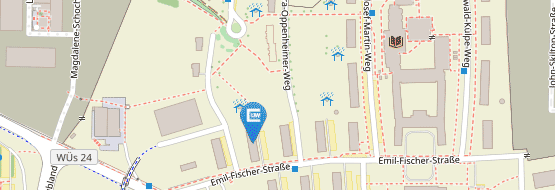
Building: 31 (Physik Ost)
Room: 02.012
E-mail: laura.eisenberger@uni-wuerzburg.de
Since 01/10/2024:
PhD candidate at the Institute for Theoretical Physics and Astrophysics / Chair of Astronomy of the Julius-Maximilians-University, Würzburg, Germany
Supervisor: Dr. Thomas Siegert
01/04/2021 – 29/01/2024:
Physics studies (M.Sc.) at Julius-Maximilians-University, Würzburg, Germany
15/09/2017 – 31/03/2021:
Physics studies (B.Sc.) at Julius-Maximilians-University, Würzburg, Germany
30/06/2017:
Abitur, Werner-von-Siemens-Gymnasium, Weißenburg, Germany
18/07/1999:
Born in Weißenburg i. Bay., Germany
INTEGRAL/SPI Observations of the M31 Dark Matter Halo
The Andromeda galaxy (M31) is a promising target for the indirect search of dark matter (DM) due to its proximity and expected massive DM halo. It functions as test case for a Milky Way (MW) like galaxy as the isotropic emission from the MW halo itself cannot be detected with a coded mask telescope like INTEGRAL/SPI. MeV data can put strong limits on DM models from the MeV up to the TeV mass range since Weakly Interacting Massive Particles (WIMPs) also produce a significant flux of secondary MeV photons from inverse Compton scattering and positron annihilation. We use the spectrum obtained from observations of M31 with SPI in order to constrain different DM models.
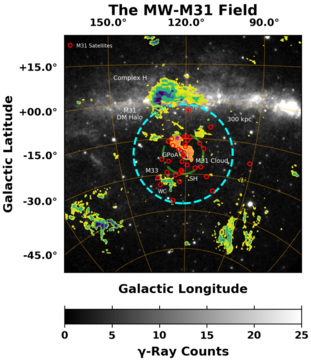
Fig. Expected halo size of the Andromeda galaxy (cyan), gas clouds along the line-of-sight and MW plane. Figure from Karwin et al. (2021).
Extension to Local Volume Galaxies and the Fermi energy range
Following cosmological N-body simulations, we will consider all observed Local Volume Galaxies (LVGs) as unbiased tracers of the DM distribution. We will use the full high-energy spectral energy distribution of secondary and tertiary photons, resulting from the interaction of charged annihilation products, together with prompt DM emission and compare this model to INTEGRAL/SPI and Fermi/LAT data. Since all galaxies share the same parameters of the underlying DM model, the cumulative signal over a broad energy range will lead to strong DM limits.
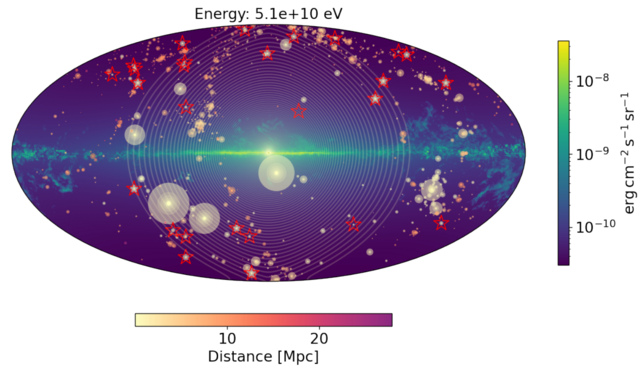
Fig. Illustration of all LVGs with their distances colorcoded and halos scaled with angular size.
Angular Power Spectrum of the cosmic MeV gamma-ray background
COSI will be the first instrument to reliably measure the diffuse cosmic gamma-ray background (CGB) and its angular power spectrum (APS) in the MeV range. The APS reveals how much structure is present at a given angular scale and thereby enables different components of the CGB to be disentangled. We will construct the CGB and its APS in the MeV band, taking into account the emission of active galaxies, type Ia supernovae, and a generalization of DM contributions from different models.
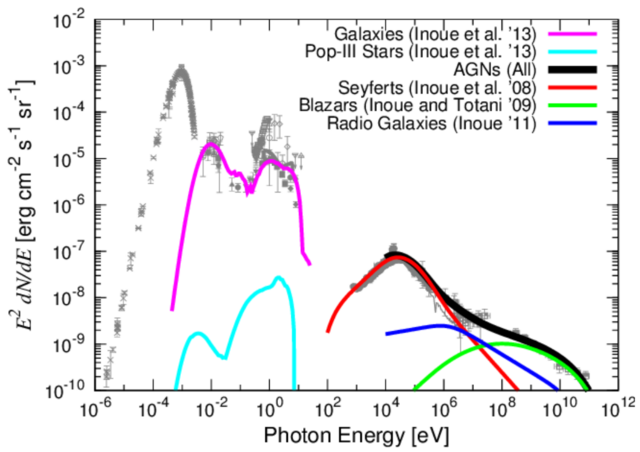
Fig. The cosmic background radiation spectrum from Inoue (2014). Here, the gamma-ray background is modeled only by contributions from different AGN types.