Recent Publications

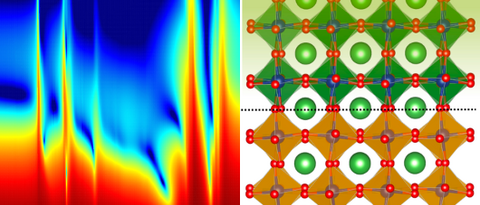
Inducing ferromagnetism by structural engineering in a strongly spin-orbit coupled oxide

Magnetic materials with strong spin-orbit coupling (SOC) are essential for the advancement of spin-orbitronic devices, as they enable efficient spin-charge conversion, complex magnetic structures, spin-valley physics, topological phases and other exotic phenomena. 5d transition-metal oxides such as SrIrO₃ feature large SOC, but usually show paramagnetic behavior due to broad bands and a low density of states at the Fermi level, accompanied by a relatively low Coulomb repulsion. Here, we unveil ferromagnetism in 5d SrIrO3 thin films grown on SrTiO(111). Through substrate-induced structural engineering, a zigzag stacking of three-unit-cell thick layers along the [111] direction is achieved, stabilizing a ferromagnetic state at the interfaces... 

Adv. Funct. Mater., 0:e00032 (2026) 


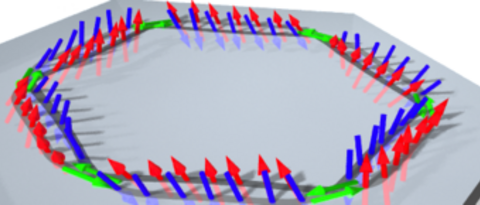
Backscattering in topological edge states despite time-reversal symmetry

Spin-momentum-locked edge states of quantum spin Hall insulators provide a compelling platform for spintronic applications, owing to their intrinsic protection against backscattering from non-magnetic disorder. This protection emerges from time-reversal symmetry, which pairs Kramers partners of helical edge modes with opposite spin and momentum, thereby strictly forbidding elastic single-particle backscattering within the pair. Yet, contrary to the
idealized notion of linear edge bands, the non-monotonic dispersions of realistic materials can host multiple Kramers pairs, reintroducing backscattering channels between them without violating time-reversal symmetry...

Nat. Commun. 16, 8209 (2025)


Bismuthene under cover: graphene intercalation of a large gap quantum spin Hall insulator

The quantum spin Hall insulator bismuthene, a two-third monolayer of bismuth on SiC(0001), is distinguished by helical metallic edge states that are protected by a groundbreaking 800 meV topological gap, making it ideal for room temperature applications. This massive gap inversion arises from a unique synergy between flat honeycomb structure, strong spin orbit coupling, and an orbital filtering effect that is mediated by the substrate. However, the rapid oxidation of bismuthene in air has severely hindered the development of applications, so far confining experiments to ultra-high vacuum conditions. Intercalating bismuthene between SiC and a protective sheet of graphene, this barrier is successfully overcome...

Adv. Mater. 37, 2502412 (2025)


Research Groups

Nanophysics at surfaces

The research activities of our group are concerned with the physics of low-dimensional systems, where the electron states resulting from dimensional confinement lead to unusual conduction properties and to phase transitions as a function of temperature.

Oxide interfaces

Our group focusses on the electronic structure of correlated systems in transition metal oxides (TMOs). Special interest lies in the interplay of different degrees of freedom (charge, spin, orbital, lattice) in the light of metal-insulator and other phase transitions.

Neutron and resonant X-ray spectroscopy

In our group we investigate complex, functional materials such as transition metal oxides, which are used in the emerging field of correlated nanoelectronics. Unlike with conventional semiconductors, exotic superconducting, orbital and magnetic states can be realized at the interfaces in layered structures comprising such materials.

Cooperations