Research
Prospective projects for doctoral researchers
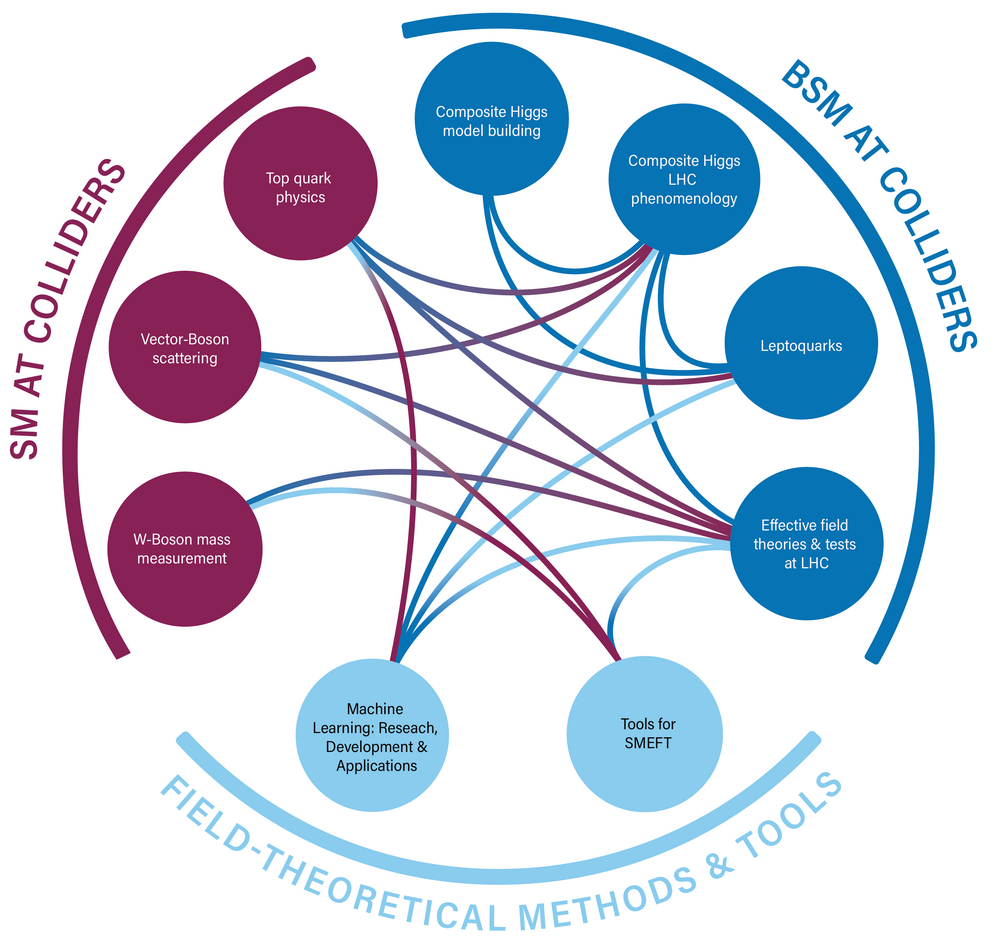
Standard Model at the LHC and prospective future colliders
- Measurement of differential cross section and gauge boson polarisation in EW VBS production of W ±Z + 2jets at the ATLAS experiment using combined Run-2 and Run-3 proton-proton collision data
- Measurement of the W mass from data with low luminosity at the ATLAS detector
- Study of colour reconnection effects in W-boson pair production in future e+e− colliders
- Higher-order electroweak corrections for future lepton colliders
Beyond the Standard Model at present and future colliders
- Combined effective field theory interpretation of differential cross section measurements of EW processes sensitive to quartic gauge couplings of SM vector bosons measured at the ATLAS experiment
- Measurements of fiducial differential cross sections of pp → t ¯t in association with heavy flavour jets, and interpretations of four heavy quark couplings in context of SMEFT operators
- Quantum tomography for SMEFT operators at future colliders
- Leptoquarks in Composite Higgs Models with a fermionic UV completion
- Search for vector-like fermions in multilepton or multiple b-jets final state
- Search for pNGBs or axion-like particles predicted in Composite Higgs models in multi-b-jets or multi-top final states
- Renormalisation of the Georgi-Machacek model
- QCD corrections to the production cross section of color sextet fermions at the LHC
Field-theoretical methods and tools
- Improved phase space sampling for unweighted event generation using modern Machine Learning methods
- Application of RG and information geometry improved training methods in particle physics
- Application and improvement of hyperbolic networks for simulated multi-top events
- Quantum information aspects of particle physics from gauge/gravity duality
- Novel approaches for the treatment of infrared singularities
- Tackling computational bottlenecks in precision predictions for the HL-LHC