Manja Zimmerer, B.Sc.

Master Student
Building: 31 (Physik Ost)
E-mail: manja.zimmerer@stud-mail.uni-wuerzburg.de
Goal: Distinguishing spatial models of massive stars and their supernovae from classical novae at the 1.8 MeV gamma-ray line from Al-26
26Al is distributed along the Galactic plane and is assumed to mostly be produced by massive stars and ejected by their winds and supernovae. However, the resulting star formation rate, SFR > 5 , does not agree with the results of other methods, suggesting 1—2 .
Considering classical novae as an additional source might help to solve this tension.
Galactic Chemical Evolution (GCE) Models yield different radial distributions of 26Al depending on the considered sources.
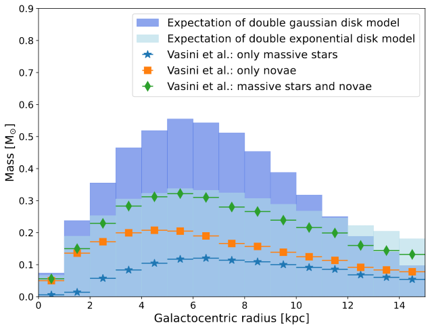
Fig. 1 Results of the GCE (Vasini et al. 2025) and geometrical distributions of masses predicted by a double exponential model and a double gaussian mode.
The Galactic distribution of 26Al, determined by considering 20 years of INTEGRAL/SPI, can be used to determine the relative contribution of source types via a Chi2 test.

Fig. 2 (left) Galactic mass distribution of 26Al for different Double Exponential Models in comparison to the source distribution predicted by Vasini et al. 2025. (right) 1 and 2 sigma results of the Chi2 test for different GCE models VV-VMd. This is strongly in favor of higher nova contributions than suggested by earlier results. (Model VV: Classical Novae + Massive Stars (Vasini et al, 2024) Model VMa-VMd: Classical Novae + Very massive stars (Vasini et al. 2024 and Martinet et al. 2022))
For this analysis, all tested source models prefer substantial nova contributions, with best-fit fractions of 77–84% and 2σ lower limits of 52–63%, lowers the SFR from 26Al γ-ray measurements accordingly to 1–2 M⊙ yr−1. Classical novae should not be neglected as sources of 26Al because the Galactic 1.8 MeV line could hardly be explained by existing massive star evolution models alone. While it is difficult to gauge both contributions directly, next generation MeV telescopes can potentially identify individual massive stars, such as γ2-Velorum.
Methods: INTEGRAL/SPI data analysis, line-of-sight integration, 3D modelling, population synthesis