Recent Publications

Helical Topological Superconducting Pairing at Finite Excitation Energies

Abstract

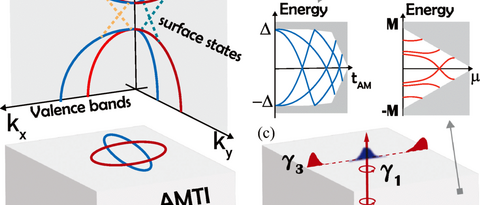
We propose helical topological superconductivity away from the Fermi surface in three-dimensional time-reversal-symmetric odd-parity multiband superconductors. In these systems, pairing between electrons originating from different bands is responsible for the corresponding topological phase transition. Consequently, a pair of helical topological Dirac surface states emerges at finite excitation energies. These helical Dirac surface states are tunable in energy by chemical potential and strength of band splitting. They are protected by time-reversal symmetry combined with crystalline twofold rotation symmetry. We suggest concrete materials in which this phenomenon could be observed.

more

Mechanism for Nodal Topological Superconductivity on PtBi2 Surface

Abstract

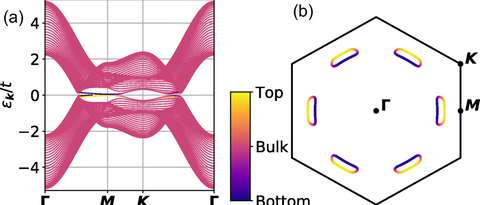
Experiments show that the Weyl semimetal PtBi2 hosts unconventional superconductivity in its topological surface states. Hence, the material is a candidate for intrinsic topological superconductivity. Measurements indicate nodal gaps in the center of the Fermi arcs. We derive that anisotropic electron-phonon coupling on Weyl semimetal surfaces, combined with statically screened Coulomb repulsion, is a microscopic mechanism for this nodal pairing. The dominant solution of the linearized gap equation shows nodal gaps when the surface state bandwidth is comparable to the maximum phonon energy, as is the case in PtBi2. We further predict that, if the screening of Coulomb interaction on the surface is enhanced by Coulomb engineering, the superconducting gap becomes nodeless, and the critical temperature increases.

more

Non-Hermitian topology in a multi-terminal quantum Hall device

Abstract

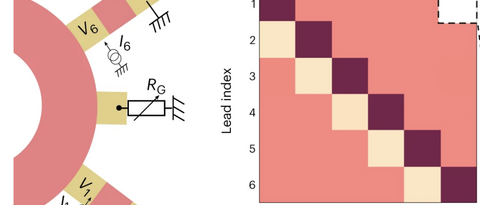
Quantum devices characterized by non-Hermitian topology are predicted to show highly robust and potentially useful properties for precision sensing and signal amplification. However, realizing them has remained a daunting experimental task, as non-Hermiticity is often associated with gain and loss, which would require precise tailoring to produce the signatures of non-trivial topology. Here, instead of gain and loss, we use the non-reciprocity of quantum Hall edge states to directly observe non-Hermitian topology in a multi-terminal quantum Hall ring. Our transport measurements evidence a robust, non-Hermitian skin effect, characterized by currents and voltages showing an exponential profile that persists across Hall plateau transitions away from the regime of maximum non-reciprocity. Our observation of non-Hermitian topology in a quantum device introduces a scalable experimental approach to construct and investigate generic non-Hermitian systems.

more