
Research topics in physics education
Augmented reality in physics lessons
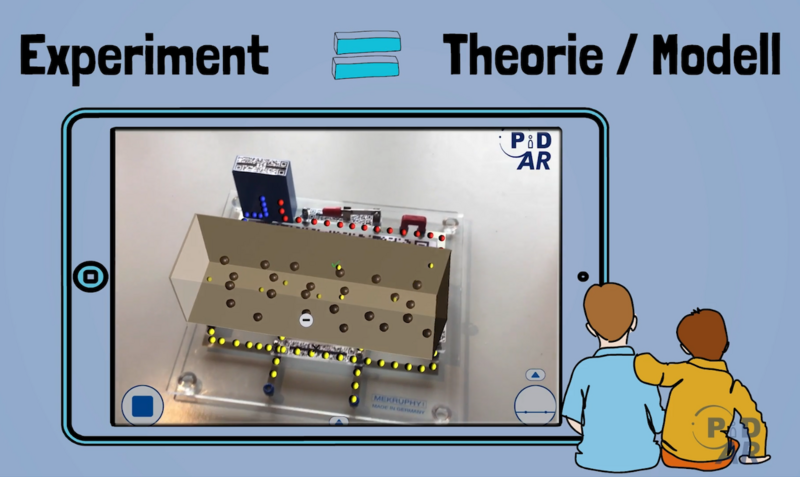
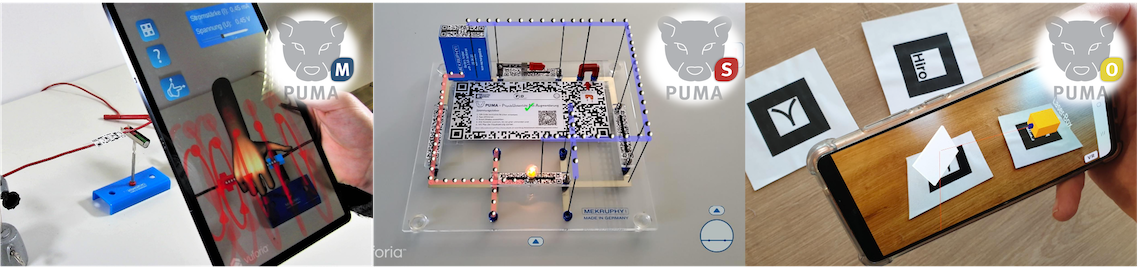
A promising application for the use of digital media in education is virtual and augmented reality. It creates opportunities (e.g. the visualisation of physical models in physics) to teach technical content in a completely new way. By linking real objects with additional digital information, the degree of abstraction for modelling is reduced, which can also counteract misconceptions. In today's society, digital media are present in all areas of the vocational world. However, this picture is not reflected in the everyday school life or university teacher training programmes. In order to respond adequately to this development, it is therefore necessary to learn how to use digital media in the classroom or as part of a degree programme, or to have access to didactically valuable materials as a teacher (preferably free of charge).
As part of three dissertations, augmented reality applications are being developed for use in school physics lessons and evaluated in terms of their learning benefits.
Further information on this topic can be found here.
Labs4Future - action-orientated climate education in the Teaching and Learning Lab
Labs4Future is an innovative, design-based research student laboratory that addresses the complexity of the climate crises through mulit-perspective, action-oriented climate education. The project engages secondary students in learning settings that aim to bridge the knowledge-action gap, while future teachers gain experience in supervising inquiry-base climate learning.
At the heart of Labs4Future lies the Lessons4Action framework, which links four domains of climate knowledge with learning pathways informed by environmental psychologyan research on the determinat of climate-related action.
A mixed-methods design examines changes in student's knowledge, attitudes, perceived behavioral control, climate-related emotions, and self-reported actions, complemented by interviews and teacher feedbach.
The published material developments are
a) Mystery: "Greenhouse effect, tipping points and local consequences of climate change combined in a large mystery download
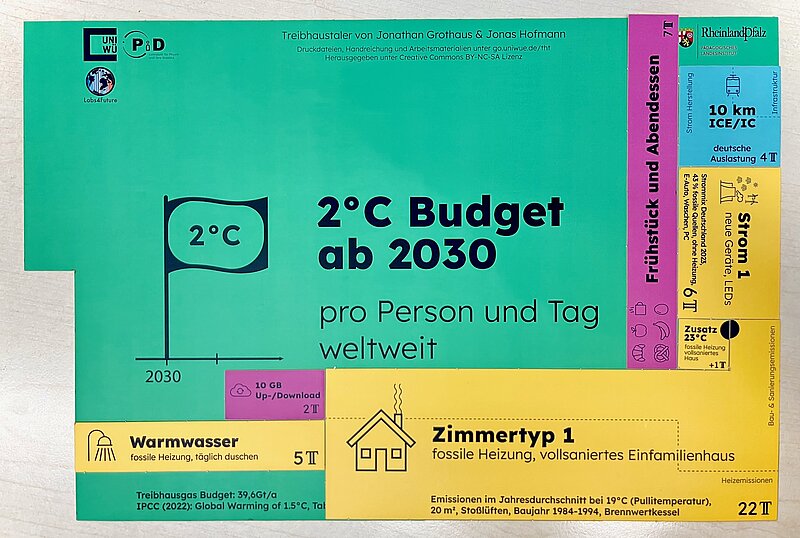
b) Carbon credits: Visual area-based representations of the emissions of an average dayHandout and working materials
c) City of the future & climate roundabout: Future workshop on structural changes in your own city/municipality Procedure
d) Among the Actions: an argumentation activity introducing climate-delay strategies and training effective counter-arguments through a rotating inner-outer circle debate.
Further information on this topic can be found here.
Possible applications of artificial intelligence (AI) in Physics Education
In our Teaching and Learning Lab for Physics we are we are pursuing innovative approaches to prepare future teachers for digital challenges in everyday school life. One focus is the use of artificial intelligence (AI), in particular chatbots based on ChatGPT.
- The first subproject (Lutz, Damköhler & Trefzger) used a comprehensive online questionnaire study to analyse AI literacy and the acceptance of AI among teacher training students at the University of Würzburg. It was found that students with experience in using AI tools perceive opportunities more clearly and assess risks as lower compared to inexperienced students. They also rated their AI skills and self-efficacy higher.
- A second subproject (Damköhler, Lutz & Trefzger) focusses on the integration of AI-supported reflection assistants in the iterative seminar format of the students lab. Two specially developed chatbots support the students: On the one hand, they help to optimise the teaching materials and support concepts based on the criteria of good teaching (classroom management, student support, cognitive activation). On the other hand, they enable students to reflect more deeply on their own teaching personality based on Korthagen's onion model.
- In the third subproject (Herz, Damköhler, Lutz & Trefzger), which was carried out as part of a master's thesis, an AI-based chatbot was used to support the development of experimental environments. Optimised through targeted prompt-engineering, the resulting chatbot is evaluated among the students in an interview study based on the Technology Acceptance Model (TAM).
All three studies are currently being continued and further developed; further research projects are being planned. There is also close collaboration with the chair's focus on "professionalisation research" in order to further promote and optimise the professionalisation of future teachers in the digital age.
Flipped classroom in physics lessons
Digitalization in schools also calls for the use and evaluation of innovative teaching concepts in physics lessons that tie in with the digital reality of school students' lives. For example, the “flipped classroom” teaching concept uses online learning videos to help students prepare for physics lessons. This frees up more time in class for active learning activities.
The effects of this teaching method in physics lessons have been and continue to be investigated in dissertations and admission papers.