ResonaTHOR wins QuantERA funding
07/27/2026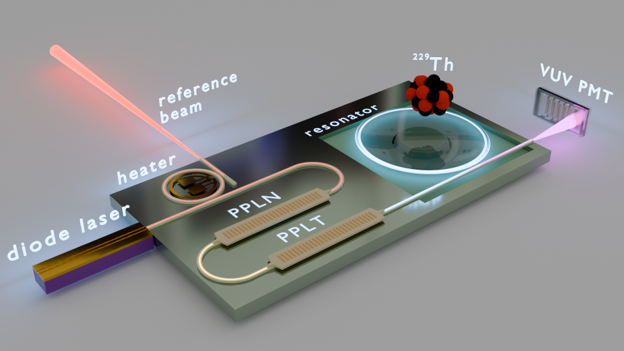
Fantastic news! We are part of a European research consortium that has been awarded funding to develop a new kind of ultra-precise time reference based on a thorium-229 nuclear clock. The project, named ResonaTHOR (Resonator-based Nuclear Optical Frequency Reference), is coordinated by Thorsten Schumm (TU Wien, Austria) and brings together world-leading experts in thorium-229, laser infrastructure and thin-film photonic platforms. It is funded through QuantERA, a collaboration of more than 40 research funding organisations that was established to strengthen the quantum ecosystem through coordinated funding.
ResonaTHOR aims to enhance the coupling between light and thorium-229 nuclei, which typically interact only very weakly. However, by placing thorium-229 inside optical resonators, light can be trapped. By forcing the light to interact repeatedly with the thorium nuclei, the project seeks to increase the light–nucleus coupling.
Adriana will contribute to the project through theoretical research on nuclear excitation, collective emission and the quantum dynamics of thorium nuclei coupled to optical resonators. The other participating research groups are led by Charles Roques-Carmes (ISTA, Austria), Lino M. C. Pereira and Sandro Kraemer (KU Leuven, Belgium), Kasper Van Gasse (Ghent University/imec, Belgium) and Pascal Del’Haye (Max Planck Institute for the Science of Light, Germany). ResonaTHOR could pave the way for a new class of quantum technologies based on nuclear states of matter: compact, robust and ultra-stable optical frequency references that can operate outside highly specialized laboratories. More details about the project and the participating research groups can be found here and here.